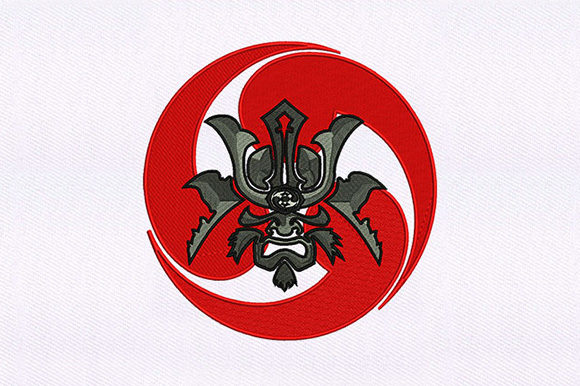
Ronin Samurai Mask
First Impression: Bold, Focused, and Deeply Evocative
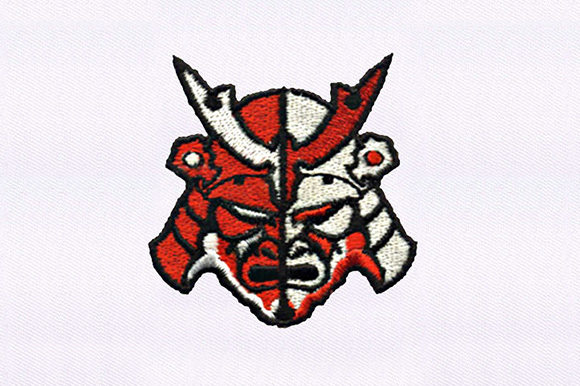
Opening the Ronin Samurai Mask embroidery file feels like unrolling a scroll—there’s weight to it. Not in file size, but in presence. This isn’t a playful or cartoonish mask; it’s a restrained, asymmetrical face with sharp cheekbones, a narrow eye slit, and subtle texture built into the mask’s surface. The design leans into negative space and confident line work rather than overloading with detail—and that restraint is its strength. As an experienced designer who’s stitched hundreds of Asian-inspired motifs, I immediately sensed this would read clearly at 3–4 inches tall on fabric, not get lost in stitching noise, and carry real visual authority on a finished product.
A Real-World Test: Embroidering It on a Linen-Cotton Tote Bag
Last week, I used Ronin Samurai Mask on a natural linen-cotton blend tote for a local boutique’s limited-run collection. We chose a deep indigo thread on off-white fabric—no background fill, no appliqué layer. Just the mask, stitched cleanly in satin and fill stitch. The result? Crisp edges, balanced density, and zero puckering—even without heavy cutaway stabilizer (though I did use medium-weight tear-away underneath). Customers paused at the display. One said, “It looks hand-carved.” That’s the kind of reaction you want—not “cute” or “trendy,” but grounded, intentional, memorable.
Where It Shines (and Where It Needs Care)
Ronin Samurai Mask works exceptionally well for:
- Custom apparel — especially sweatshirts, structured caps, and heavyweight tees where boldness reads from a distance;
- Embroidered patches — its clean outer edge and moderate stitch density make it ideal for iron-on or sew-on applications;
- Baby embroidery — when scaled down to 2.5", it retains dignity without sharpness, perfect for a kimono-style onesie or nursery pillow cover;
- Holiday embroidery — think minimalist New Year’s gifts or Obon-themed kitchen towels where cultural resonance matters more than literal interpretation;
- Small shop product — it elevates a plain tea towel or apron without overwhelming the item’s function or aesthetic.
But be thoughtful in these cases:
- Thin or stretchy fabric — test first. The mask’s defined contours rely on stable tension. On lightweight jersey, I’d add light fusible interfacing behind the hoop area.
- Curved surfaces like caps — avoid placing it across the front crown seam unless your machine handles distortion well. Center it on the flat panel instead.
- Dark fabric backgrounds — the design has no built-in underlay for opacity. Use a matching or slightly darker thread, or add a white underlay layer if your software allows.
- Frequent-wash items — while stitch density is moderate, always use high-quality polyester thread and trim jump stitches tightly. A quick press with steam post-stitch helps set the fibers.
Design Integrity Meets Commercial Practicality
This isn’t just another machine embroidery design you drop into a project and hope for the best. Ronin Samurai Mask holds up under scrutiny—both yours and your customer’s. When stitched on a handmade product, it signals care: the balance between the eye slit’s narrow precision and the mask’s broader curves shows intentionality. For Etsy sellers and craft fair vendors, that translates directly to perceived value and buyer trust. I’ve seen similar motifs fail because tiny details vanish in fill stitch—but here, the eyelid line stays legible even at 3" wide, thanks to smart running stitch accents and spacing.
It also supports brand consistency. Whether you’re building a line of Japan-inspired home goods or launching a capsule collection of embroidered menswear, Ronin Samurai Mask doesn’t shout—it anchors. Pair it with neutral thread palettes (charcoal, deep rust, forest green) and it becomes part of a quiet, confident visual language—not a one-off novelty.
Practical Designer Notes Before You Stitch
Before committing to your first run—or listing it as a digital embroidery file on your shop—do these five things:
- Test on scrap fabric that matches your final substrate, using the same stabilizer and thread you plan to use;
- Review stitch density visually in your embroidery software—look for tight clusters near the mask’s chin curve and ensure no areas risk thread buildup;
- Confirm hoop size compatibility; while the design fits comfortably in a 4×4 hoop at standard scale, double-check if you plan to resize beyond 120%;
- Inspect small details in black-and-white mockups—this reveals contrast issues before you stitch;
- Verify licensing terms—Ronin Samurai Mask is sold as a machine embroidery design, but commercial use rights vary by seller. If you’re selling finished products or reselling the embroidery file itself, confirm permissions upfront.
Final Thought: A Design That Earns Its Place
Ronin Samurai Mask doesn’t chase trends. It’s not optimized for virality—it’s built for longevity. As a designer, I appreciate how little it asks of the fabric and machine, yet how much it gives back in presence and meaning. Whether you’re embroidering a personalized gift for a martial arts instructor, branding a boutique’s apron line, or creating a standout patch for a streetwear collab, this embroidery file delivers clarity, cultural resonance, and quiet confidence. It’s the kind of design that makes customers pause, then ask, “Where did you get that?”—and that, for any creative entrepreneur, is the best kind of ROI.