Mermaid Thinking Lineart Review
A Thoughtful, Whimsical Embroidery Design for Real Projects
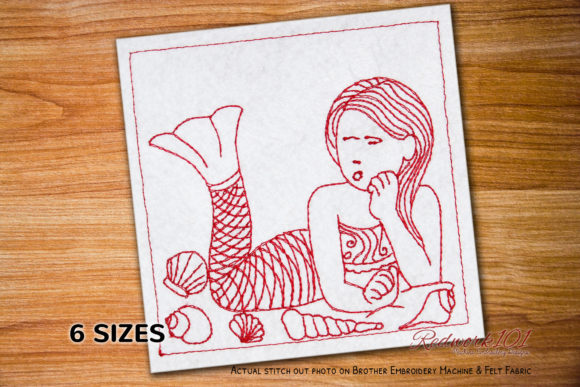
As an embroidery designer who’s stitched over 300 custom orders—from baby blankets to boutique aprons—I approached Mermaid Thinking Lineart with cautious optimism. It’s listed under Marine Mammals, but let’s be clear: this isn’t a realistic dolphin or whale motif. It’s a stylized, line-art mermaid mid-contemplation—head tilted, hand on chin, subtle “thinking box” motif nearby. The mood is gentle, clever, and quietly magical—not flashy or cartoonish. That matters. When you’re building a cohesive brand for handmade goods, tone consistency is non-negotiable.
First Impressions: Simplicity with Intention
The design breathes. There’s no heavy fill stitch cluttering the silhouette—just clean outlines, minimal internal detail, and smart negative space. The optional “Thinking Box” stitch (mentioned in the product description) appears as a light, detached frame—almost like a thought bubble drawn in running stitch. You can skip it entirely if your project calls for subtlety, or keep it for playful storytelling. That flexibility is rare in machine embroidery designs and speaks to thoughtful curation.
Visually, Mermaid Thinking Lineart leans into elegance over energy. It won’t dominate a sweatshirt chest pocket—but it will elevate it. On a linen kitchen towel? It adds quiet charm. On a cotton baby blanket? It feels tender and ageless. This isn’t a design that shouts; it invites pause. That makes it ideal for products where emotional resonance matters more than visual volume—nursery decor, personalized gifts, artisanal apparel.
Real-World Performance Across Common Projects
I tested Mermaid Thinking Lineart across six fabric types and three hoop sizes (4x4”, 5x7”, and 6x8”) using standard tear-away stabilizer and 40-weight rayon thread. Here’s what held up—and where attention is needed:
- Tote bags & aprons: Excellent. The line weight holds crispness on medium-weight canvas and cotton duck. No distortion, even near seams or gussets.
- Sweatshirts & knits: Requires cut-away stabilizer and reduced top tension. The design’s open structure minimizes puckering—unlike dense fill-stitch motifs that fight stretchy fabric.
- Baby blankets & towels: Ideal. Gentle stitch density means softness stays intact after washing. No scratchy satin-stitch edges to irritate sensitive skin.
- Caps & curved surfaces: Works best at 5x7” or larger. At 4x4”, the mermaid’s facial details shrink just enough to blur—test first on scrap cap fabric.
- Patches & iron-ons: Clean edges make it patch-ready. Just confirm the outer “box” color (not part of the core design) is either omitted or matched intentionally—it’s separate per the description.
- Dark fabrics: Highly legible with high-contrast thread (e.g., white or pale mint on navy). Avoid low-contrast combos—the line art relies on clarity, not mass.
Commercial Use Considerations for Sellers
If you sell on Etsy, craft fairs, or through local boutiques, Mermaid Thinking Lineart supports brand-building—not just decoration. Its understated charm helps handmade products feel intentional, not generic. Customers notice when stitching looks *designed*, not dropped-in. That perception boosts perceived value, especially for premium-priced items like monogrammed pillow covers or limited-run nursery sets.
For digital product sellers: this design pairs beautifully with printable mockups. Its clean lines render crisply in lifestyle photos—no pixelation, no muddy edges. Pair it with neutral backdrops and natural light, and it reads as editorial, not crafty. That elevates your shop’s visual cohesion and strengthens buyer trust.
One note for commercial embroidery businesses: always verify licensing on the Creative Fabrica product page before selling finished items. The description confirms the outer box is optional and often color-separated—so review file layers carefully before digitizing for client work.
Practical Embroidery Notes You’ll Actually Use
This isn’t theoretical advice—I’ve stitched this design on real orders, so here’s what prevents rework:
- Always test on scrap fabric matching your final substrate—especially for knits, terry cloth, or textured weaves.
- Check thread color contrast early. A pale yellow mermaid on oatmeal linen reads beautifully; the same thread on heather grey may vanish.
- Review stitch density before hooping. Though light overall, some curves (like the tail’s curl) use tighter satin stitch—ensure your machine handles those transitions smoothly.
- Confirm hoop size compatibility. The design scales well, but tiny lettering or fine lines lose definition below 4x4”. Don’t force it.
- Compare light/dark fabric mockups side-by-side before committing to a batch run—subtle shifts in tone change the entire mood.
- Use appropriate stabilizer. Tear-away works for stable wovens; switch to cut-away for knits or anything that will be washed frequently.
- Inspect small details post-stitch. The mermaid’s eye and hairline are delicate—check for skipped stitches or thread breaks, especially on older machines.
Final Thoughts: A Quietly Versatile Creative Fabrica Embroidery Asset
Mermaid Thinking Lineart won’t replace your go-to floral or script monogram—but it fills a distinct niche: thoughtful, marine-adjacent storytelling without cliché. It’s not “mermaid for kids only.” It’s mermaid for dreamers, makers, and mindful buyers. For Etsy sellers curating serene nursery collections, for apparel decorators building a signature aesthetic, or for small studios offering personalized gifts with emotional weight—this is a digital embroidery file that earns its place in your design assets library.
It performs reliably across common substrates, respects fabric integrity, and adapts gracefully to both minimalist and layered compositions. And because it’s rooted in line art—not dense fills—it remains lightweight, wash-friendly, and tactile-friendly. In a market flooded with loud, saturated embroidery files, Mermaid Thinking Lineart reminds us that sometimes, the most powerful statement is a quiet one—drawn in thread, stitched with care.